

Challenge 1
Access to audiology services in regional and remote communities is limited
Wait lists of months or years, and fly-in-fly-out clinicians, cannot sustain a successful community hearing programme.
Community & First Nations Health
Sound Scouts is appropriate for use in remote and regional communities. The Automatic Audiometer offers a language independent test option and the Triple Factor Hearing Screener identifies middle ear, inner ear and listening difficulties in noise.
The Challenge
Challenge 1
Wait lists of months or years, and fly-in-fly-out clinicians, cannot sustain a successful community hearing programme.
Challenge 2
The Triple Factor Hearing Screener identifies middle ear, inner ear and listening in noise issues. Language-free testing is offered via the Automatic Audiometer.
Challenge 3
Chronic ear disease requires frequent, low-barrier monitoring across a community.
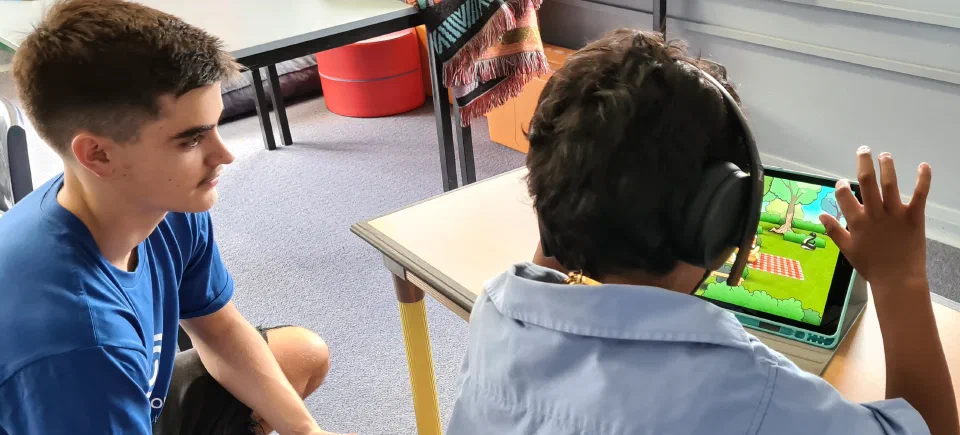
The Triple Factor Hearing Screener (TFHS) and Automatic Audiometer (AA) can be administered by community health workers using a touchscreen device and headphones without specialist hearing equipment. SSIMPL enables tracking of results across community visits to support identification of individuals who need further assessment.
How it works
Where spatial processing disorder is diagnosed via the APD Suite, your clinician may discuss Soundiverse — an auditory training program currently in beta. Learn more about Soundiverse →
We work with community health organisations across Australia. Contact us to discuss your setting.
Validated in community settings
Published research — First Nations communities
"Detection of hearing problems in Aboriginal and Torres Strait Islander children: a comparison between clinician-administered and self-administered hearing tests." 88% agreement between the Sound Scouts Automatic Audiometer and manual audiometry. (International Journal of Audiology, 2020)
About LiSN-U
LiSN-U was developed at Macquarie University. Its phonemes are drawn from languages common to most communities worldwide, making it suitable for use with many non-English speaking populations.
