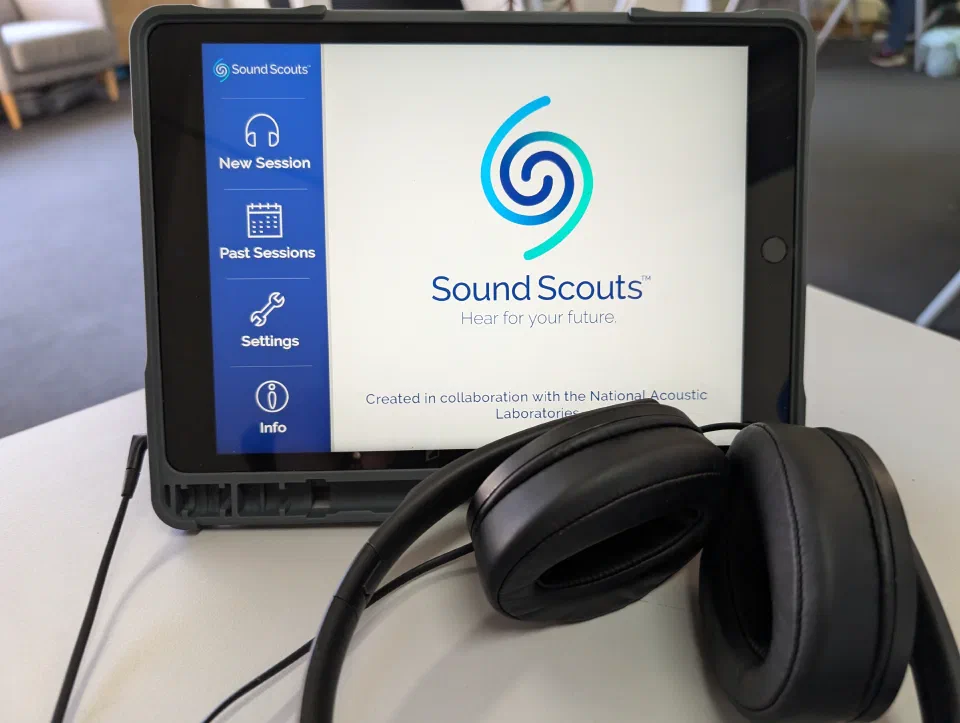
Hearing tests are just child's play: the Sound Scouts game for children entering school
Harvey Dillon, Carolyn Mee, Cuauhtemoc Moreno & John Seymour
National Acoustic Laboratories & Sound Scouts, Sydney
International Journal of Audiology, 2018 ↗
(opens in new tab)
Why this source matters: this study was published in the field's
leading peer-reviewed journal, meaning its methodology and results were reviewed
by independent experts before publication. The test itself was developed with the
National Acoustic Laboratories, the research arm of Hearing Australia.
Objective: To create a hearing test usable without the involvement
of a clinician or calibrated equipment, suitable for children aged 5 or older.
Design: The touch screen based app includes a test of speech in quiet,
speech in noise and tones in noise, all embedded in a game designed to maintain
engagement. Data was collected to intelligibility-equalise the stimuli, establish
normative performance, and evaluate the sensitivity with which Sound Scouts detected
known hearing problems and identified their type.
Study sample: Children aged 5 to 14 (394 with normal hearing,
97 with previously identified hearing loss) and 50 adults with normal hearing.
Results: With pass–fail criteria set such that 98% of children
with normal hearing passed, 85% of children with hearing loss failed Sound Scouts.
No child with four-frequency average hearing thresholds of 30 dB HL or
greater in their poorer ear passed.
“Sound Scouts has specificity and sensitivity sufficiently high to provide
hearing screening around the time children typically enter school.”